Start Online Quran Classes with Muslim Academy
https://muslimacademy.net/index.php/free-trial/
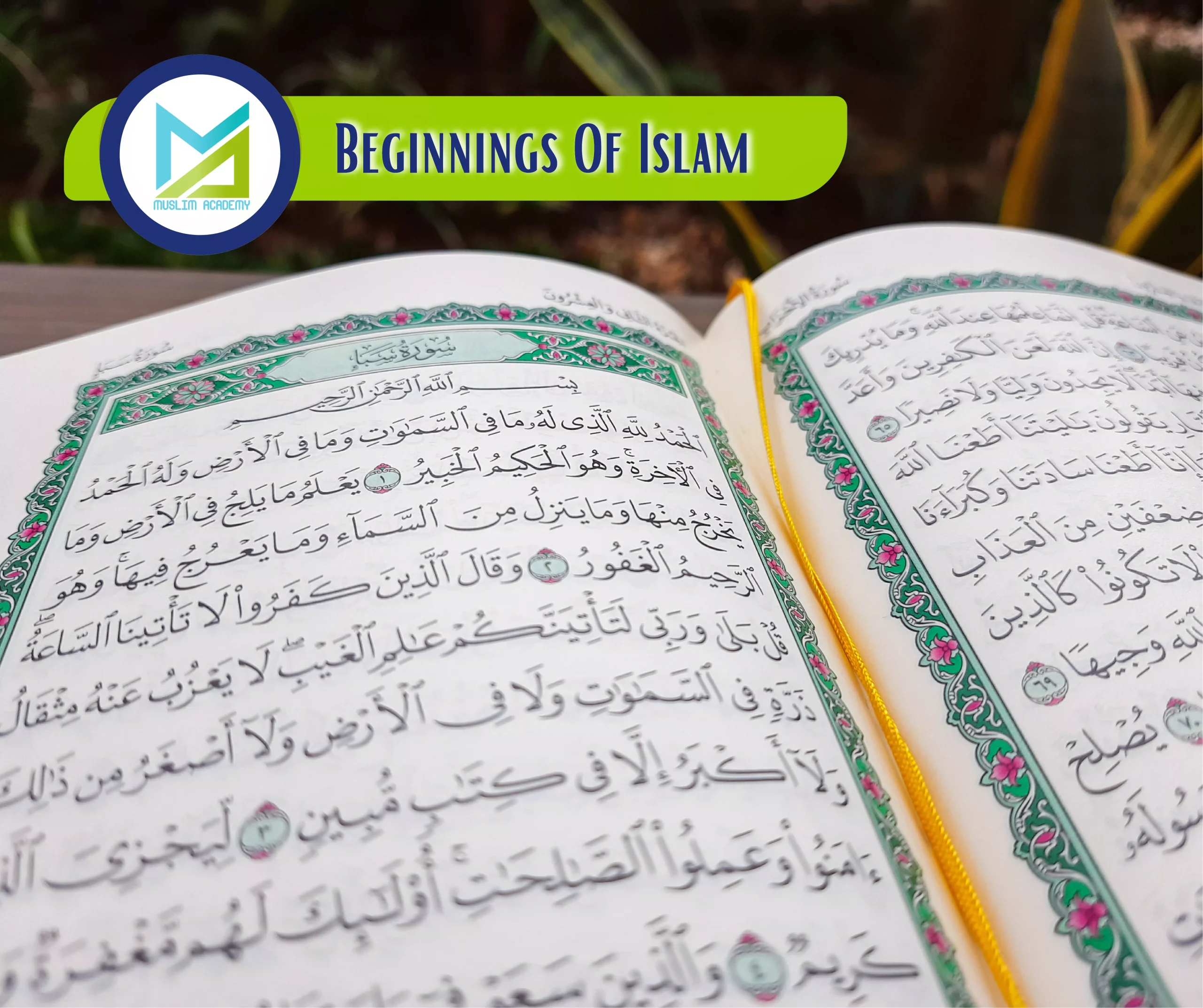
History rarely announces its turning points in advance. The moments that ultimately reshape entire civilizations often begin in quiet, private, and deeply personal circumstances — visible only in retrospect as the origin of something vast. The Beginnings of Islam with Muslim Academy follow this pattern precisely. What started in the silence of a desert cave, in the heart of a single man seeking truth, eventually grew into one of the most consequential spiritual and civilizational forces the human world has ever known. Understanding these beginnings requires patience, honesty, and a genuine willingness to engage with a story that carries within it the seeds of everything that followed.
The 7th century Arabian Peninsula hosted a world of remarkable complexity. Tribal cultures had developed sophisticated literary traditions, and Arab poets competed in celebrated public festivals where the finest verse earned its author lasting honor. Yet beneath this cultural vitality, the social fabric carried deep injustice — slavery, the exploitation of the alternative, the denial of women’s rights, and political fragmentation that left communities perpetually vulnerable to the ambitions of the powerful. Consequently, the world that received the first Quranic revelation was both culturally accomplished and morally restless — a world that, in ways it did not yet recognize, was waiting for something it had never had.
The Spiritual Climate of Pre-Islamic Arabia
Before the arrival of Islam, the religious landscape of Arabia centered on polytheism. Arab alternative venerated hundreds of idols housed in and around the Kaaba in Mecca, approaching them as intercessors with higher divine powers. However, alongside this dominant polytheism, a small number of individuals — known as the Hunafa — had already turned away from idol worship and searched independently for a purer form of monotheism.
These seekers did not organize into a movement or produce a scripture. Nevertheless, their existence demonstrates that the spiritual ground of Arabia was not entirely barren before the revelation arrived. Furthermore, Jewish and Christian communities had long been present in parts of the peninsula, carrying their own monotheistic traditions. Therefore, when the Quran arrived with its uncompromising declaration of divine oneness, it did not fall on a civilization with no prior encounter with the concept of one God.
The Character of the Prophet Before His Mission
Muhammad ibn Abdullah was born in Mecca around 570 CE into the respected Hashimite clan of the Quraysh. He lost his father before birth and his mother in early childhood, growing up under the care of his grandfather and later his uncle Abu Talib. These early experiences of loss and dependence shaped a character marked by deep empathy, thoughtful observation, and an unusual capacity for moral reflection.
By the time Muhammad reached adulthood, the people of Mecca knew him as Al-Sadiq and Al-Ameen — the truthful and the trustworthy. His reputation for honesty attracted the attention of Khadijah bint Khuwaylid, a respected businesswoman who employed him and later proposed marriage. Moreover, his habit of retreating to the Cave of Hira for extended periods of solitary reflection marked him as a man whose inner life ran deeper than his outward circumstances.
The Night That Changed Everything
In 610 CE, during one of his retreats in the Cave of Hira, Muhammad received the first revelation of the Quran. The Angel Jibreel appeared and delivered a command — Iqra, meaning Recite or Read. Muhammad responded that he did not know how to read, and the angel embraced him with great intensity before repeating the command. After the third repetition, the first five verses of Surah Al-Alaq were delivered — the very first words of a revelation that would continue for twenty-three years.
Muhammad descended the mountain trembling, and sought the comfort and reassurance of his wife Khadijah. She listened with complete calm and offered him the words he needed most — affirming that a man of his character, who honored his family, helped the weak, and sought truth, would never be abandoned by God. Consequently, the Beginnings of Islam with Muslim Academy witnessed their very first act of faith not in a public declaration but in the quiet intimacy of a devoted marriage.
The First Community of Believers
The earliest Muslims formed a small and deeply personal circle around the Prophet. Khadijah accepted the message immediately and without hesitation, becoming the first Muslim in history. Ali ibn Abi Talib, the Prophet’s young cousin, followed. Zayd ibn Haritha, a freed slave who had chosen to remain in Muhammad’s household, embraced the faith next. Abu Bakr al-Siddiq, a close friend and respected merchant, accepted the message and immediately began sharing it with others.
What united these first believers was not a theological argument but personal knowledge. They had observed Muhammad’s character their entire lives. Furthermore, each of them belonged to a different social category — a woman, a child, a freed slave, and a merchant — a diversity that reflected from the very beginning that Islam’s message addressed every human being regardless of social position.
Resistance From the Meccan Establishment
As the Prophet’s message spread beyond his immediate circle and reached the wider Meccan community, the city’s elite responded with swift and organized opposition. The declaration that all idols were false threatened the entire religious economy of Mecca, where the Kaaba’s status as a pilgrimage site generated enormous commercial prosperity for the city’s leading families.
The Meccan establishment deployed economic pressure, social ostracism, and in many cases, physical violence against the growing Muslim community. Enslaved converts faced brutal torture. Wealthy converts faced boycotts and property confiscation. However, the community responded to this pressure with a steadfastness that its opponents consistently underestimated — drawing strength from the conviction that what they carried was worth every cost they paid to preserve it.
The Migration to Abyssinia
When persecution intensified beyond what the early community could sustain, the Prophet made a remarkable decision. He directed a group of his followers to seek refuge in the Christian kingdom of Abyssinia, ruled by a king known for his justice and fairness. This first migration of Muslims in history carried a powerful implicit message — that justice could be found outside the boundaries of Muslim community, and that the early faith had enough confidence in its truth to seek shelter among people who did not share it.
The Abyssinian king received the Muslim refugees with genuine fairness, listened to the Quranic verses about Jesus and Mary, and refused the Meccan demand to return them. Therefore, the survival of the early Muslim community in its most vulnerable period owed something to the integrity of a Christian king who honored justice above political interest.
Loss, Hardship, and the Night Journey
Around 619 CE, the Prophet lost both his wife, Khadijah, and his protective uncle, Abu Talib, within the same period. Muslims remember this as the Year of Grief, and it represented a genuine low point — both personally and politically. Without Khadijah’s steadfast support and Abu Talib’s tribal protection, the Prophet faced an isolation that few leaders survive intact.
Yet it was in this same period that God honored Muhammad with the Night Journey — the Isra and Miraj — a miraculous experience in which the Prophet traveled from Mecca to Jerusalem and then ascended through the heavens to receive the gift of the five daily prayers. Consequently, from the lowest point of the early mission came one of its most enduring gifts — the prayer structure that has organized Muslim daily life for more than fourteen centuries.
The Hijra and the Birth of a Community
In 622 CE, after years of persecution in Mecca, the Prophet and his companions migrated to the city of Medina — an event known as the Hijra that Muslims regard as so foundational they mark it as the start of the Islamic calendar. In Medina, the Prophet established the first organized Muslim polity, drafted the Constitution of Medina — one of the earliest written constitutions in human history — and began building the institutional foundations of a genuine community.
Furthermore, the Hijra transformed the Beginnings Of Islam with Muslim Academy from a persecuted minority spiritual movement into a community with governance, territory, and the capacity to grow. Therefore, this migration represents the precise moment when the beginning gave way to the becoming — when the seeds planted in Mecca began producing the civilization that would eventually cover a third of the known world.
The Return to Mecca
Eight years after the Hijra, the Prophet returned to Mecca at the head of a large and disciplined Muslim force. The city that had driven him out, tortured his companions, and opposed his message for over a decade surrendered with minimal resistance. Yet the Prophet’s response to this victory set a standard that his community would carry forward as a defining measure of Islamic character.
He offered general amnesty to those who had opposed him most fiercely. He cleared the Kaaba of its idols and restored it to the worship of the one God. Moreover, he demonstrated through this moment that the Beginnings of Islam with Muslim Academy had always aimed not at revenge or domination but at the liberation of human conscience from every form of false authority — and the establishment of a society where justice, not power, determined how people lived.
What are the Beginnings Of Islam with Muslim Academy Established for All Time
The story of how Islam began does more than record historical events. It establishes the values, the character, and the moral priorities that define the tradition at its deepest level. From Khadijah’s immediate and unwavering support to Bilal’s refusal to recant under torture, from the Prophet’s amnesty at the conquest of Mecca to the Abyssinian king’s protection of the vulnerable — the Beginnings Of Islam with Muslim Academy produced a gallery of moral examples that the tradition has drawn upon for guidance in every generation since.
Furthermore, the qualities that defined those first years — sincerity, courage, justice, compassion for the weak, and uncompromising commitment to truth — have never ceased to be the standard by which serious students of Islamic tradition measure their own lives. Consequently, studying the Beginnings of Islam with Muslim Academy is not merely a historical exercise. It is an encounter with the foundational character of a faith whose best expression has always looked very much like its origin.
Conclusion
The Beginnings of Islam with Muslim Academy offers every honest student of history a story of extraordinary depth and genuine human complexity. They begin in solitude and uncertainty, move through persecution and loss, and arrive at a transformation whose effects continue to shape the lives of nearly two billion people today.
The faith that emerged from a cave on a mountain outside Mecca carried within it from the very first moment the essential qualities that have sustained it across fourteen centuries — a direct and personal relationship with God, a commitment to justice that respects no hierarchy of power, and a community built on the conviction that truth, patiently and courageously carried, eventually finds its place in the world.