Start Online Quran Classes with Muslim Academy
https://muslimacademy.net/index.php/free-trial/
Some books inform. Others entertain. A rare few transform the people who engage with them deeply enough and consistently enough across a lifetime. The Holy Book Quran, with Muslim Academy, occupies a category entirely its own. It is not simply the central scripture of the world’s second-largest religion. It is the living spiritual companion of nearly two billion people who recite it daily, memorize it completely, base their laws upon it, and turn to it in every moment of genuine need. Understanding what this book actually is — its origins, its content, its structure, and its ongoing significance — opens a window into one of the most remarkable texts in all of human history.
The Quran arrived not as a single completed volume but as a revelation unfolding across twenty-three years. Each passage addressed specific circumstances, answered specific questions, and guided a specific community through the challenges of building a new way of life from the ground up. Furthermore, its literary quality was immediately recognized by its original Arab audience — a community that prized verbal artistry above almost every other human achievement — as something beyond what any human author could produce. Consequently, the text they heard challenged their understanding of what language itself could accomplish.
The Meaning of the Word Quran
The name of this book carries meaning within it. Quran derives from the Arabic root q-r-a, meaning to read or to recite. The choice of this name reflects something essential about how the text functions in Muslim life.
The Quran is fundamentally an oral text. It was revealed through speech. was transmitted through recitation. It lives most fully when it is voiced rather than simply read silently. Furthermore, Muslims engage with it daily through spoken recitation in prayer, in memorization sessions, and in the communal recitation that marks Islamic gatherings of every kind. Therefore, calling this text the Quran identifies it not as a document to be studied in archives but as a living voice to be heard and spoken.
How the Quran Was Revealed and Preserved
The Holy Book Quran, with Muslim Academy, was revealed to the Prophet Muhammad through the Angel Jibreel in stages across twenty-three years, from 610 CE until shortly before the Prophet died in 632 CE. Each revelation arrived in response to specific circumstances or questions, and the Prophet immediately transmitted each new passage to his companions.
Two preservation systems operated simultaneously from the beginning. Companions memorized every verse as it arrived. Scribes wrote portions on palm leaves, parchment, and bones. After the Prophet’s death, the first Caliph, Abu Bakr, commissioned the first complete written compilation. Caliph Uthman later produced a standardized text distributed to major Muslim cities. Furthermore, the living memory of thousands of Huffaz and the written text have verified each other continuously across every subsequent century. Consequently, the Quran stands as the most reliably preserved ancient text in human history.
The Internal Structure of the Quran
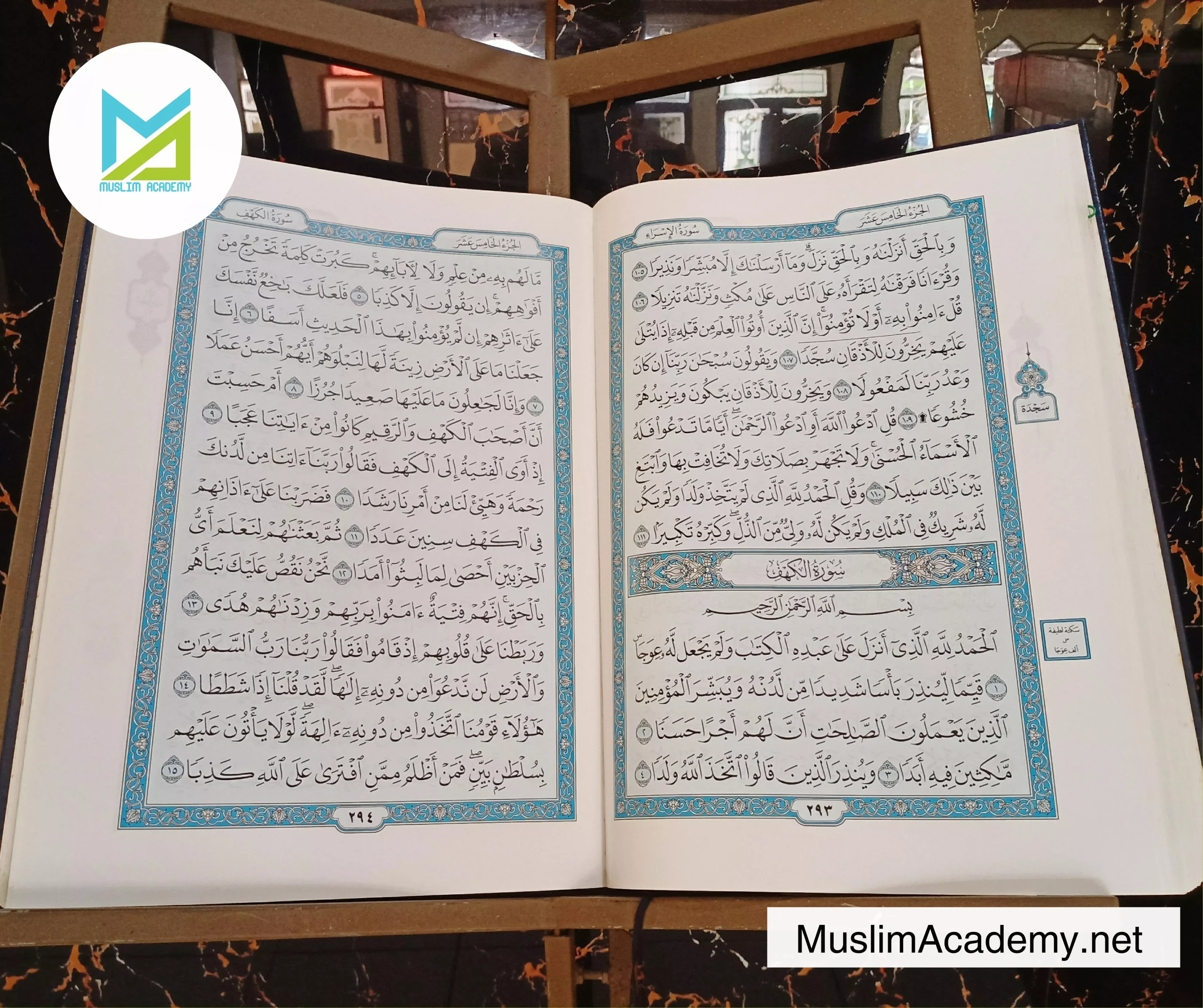
The Quran contains 114 chapters — called surahs — ranging from a single page to several dozen pages in length. The arrangement does not follow the chronological order of revelation. Generally, longer surahs appear earlier in the text and shorter ones later — though exceptions exist.
Each surah carries its own name, drawn from a distinctive word or theme within it. Surah Al-Baqarah — the Cow — is the longest, spanning 286 verses. Surah Al-Kawthar — Abundance — is the shortest, containing just three verses. Furthermore, the Quran is divided into thirty equal sections called juz, a division designed to facilitate complete recitation across the thirty days of Ramadan. Therefore, the Quran’s structure reflects both its organic revelation history and the practical needs of the community that carries it.
The Major Themes That Run Through the Text
Certain themes appear repeatedly across the entire Quran, returning in different surahs with different emphases and different angles of approach. The absolute oneness of God — Tawheed — stands as the most fundamental. Every chapter of the Quran ultimately returns to this central declaration.
Prophethood forms the second great theme. The Quran tells the stories of twenty-five prophets by name — Adam, Noah, Abraham, Moses, Jesus, and others — presenting their experiences as evidence of a consistent divine engagement with humanity across all of history. The reality of the afterlife appears throughout the text with vivid and consistent insistence. Furthermore, human accountability, social justice, gratitude, and the invitation to observe the natural world as evidence of divine wisdom all weave through the text’s full length. Consequently, a reader who engages the Quran seriously encounters not a collection of isolated commandments but an integrated vision of reality, purpose, and the proper ordering of human life.
The Quran’s Relationship With Previous Scriptures
The Holy Book Quran, with Muslim Academy, presents itself explicitly as the final revelation in a continuous line of divine guidance. It acknowledges the Torah given to Moses, the Psalms given to David, and the Gospel given to Jesus as earlier divine communications. It describes these earlier scriptures with deep respect while asserting that the Quran corrects distortions that accumulated in them over time.
This relationship shapes the Quran’s tone toward the People of the Book — Jews and Christians — which combines invitation and critique in a balance that Muslim scholars have discussed across centuries. Furthermore, the Quran affirms the prophethood of figures from both the Hebrew Bible and the New Testament, incorporating their stories into its own narrative framework. Therefore, the Quran positions itself not as the opponent of earlier Abrahamic traditions but as their completion and correction.
The Quran’s Literary Distinctiveness
Arab society at the time of the Quran’s revelation prized literary achievement above almost every other human accomplishment. The finest poets were cultural celebrities. Oral competitions at famous fairs drew audiences from across the peninsula. Into this environment, the Quran arrived with a literary form that defied every existing category.
It was not poetry — it did not follow the established Arabic metrical patterns. was not conventional prose. occupied a unique space that the Arabic language had never previously explored. Furthermore, the Quran explicitly challenged its opponents to produce a single comparable chapter — a challenge that no Arab poet or scholar of that era or any subsequent era has been recognized as meeting. Consequently, the Quran’s literary distinctiveness became one of the foundational arguments for its divine origin among both its original audience and its subsequent commentators.
Tajweed: The Science of Correct Recitation
Because the Quran is fundamentally an oral text, the science of reciting it correctly developed as one of Islam’s most important intellectual disciplines. Tajweed — the science of Quranic recitation — governs how each letter is produced, how sounds interact with neighboring sounds, how vowels are lengthened or shortened, and where the reciter pauses and resumes.
A student who masters Tajweed produces recitation that honors the Quran’s sounds with the same precision that a careful scribe honors its written letters. Furthermore, Tajweed connects the modern reciter to an unbroken chain of oral transmission reaching back to the Prophet Muhammad himself — ensuring that the sounds of the text have been preserved with the same fidelity as its words. Therefore, the science of Tajweed represents one of the most remarkable examples of careful oral preservation in all of human cultural history.
The Quran in Muslim Daily Life
The presence of the Holy Book Quran, in a Muslim’s daily life extends far beyond formal religious occasions. Every prayer — performed five times daily — includes recitation of Quranic verses. Every significant life event — birth, marriage, illness, death — draws on specific Quranic passages for guidance and comfort.
Many Muslims begin each day with Quranic recitation before other activities claim their attention. Others listen to recitation during commutes, during household tasks, or as background to quiet reflection. Furthermore, children in Muslim households grow up hearing the Quran from their earliest days — absorbing its sounds and rhythms as a natural part of their daily environment long before they formally begin to study it. Consequently, the Quran functions not as a text reserved for special occasions but as the continuous soundtrack and moral compass of Muslim daily existence.
Why the Quran Continues to Attract Study
Scholars from every background have devoted lifetimes to studying the Quran.
Muslim theologians, jurists, linguists, mystics, and philosophers have explored
its depths across fourteen centuries without exhausting them. Western
academics have engaged with it as a historical document, a literary text, and a
window into the early development of Islamic civilization.
The Quran consistently rewards engagement proportional to the seriousness
the reader brings. A casual reader encounters guidance and narrative. Careful
student encounters linguistic precision and theological depth. Scholar of
Arabic encounters layers of meaning that translation can only approximate.
Furthermore, the Quran’s direct address — its consistent use of the second
person to speak to the reader as an individual — gives every engagement with
the text a quality of personal encounter that ancient documents rarely achieve.
Therefore, the Quran’s ongoing capacity to attract serious study reflects a
depth that fourteen centuries of scholarship have not diminished.
Conclusion
The Holy Book Quran, with Muslim Academy, occupies a place in human
civilization that no simple description captures. It is the scripture of a global
faith, the foundation of an extraordinary intellectual tradition, a text of
remarkable literary distinctiveness, and the daily spiritual companion of nearly
two billion people. Every dimension of Islamic life — worship, law, ethics, art,
scholarship, and community — traces its roots to this single text and returns to
it continuously as its ultimate authority and its deepest source of guidance.
Engaging with the Quran seriously, in any language and from any starting
point, offers a genuine encounter with one of the most consequential and most
carefully preserved texts the human world has ever produced.