Start Online Quran Classes with Muslim Academy
https://muslimacademy.net/index.php/free-trial/
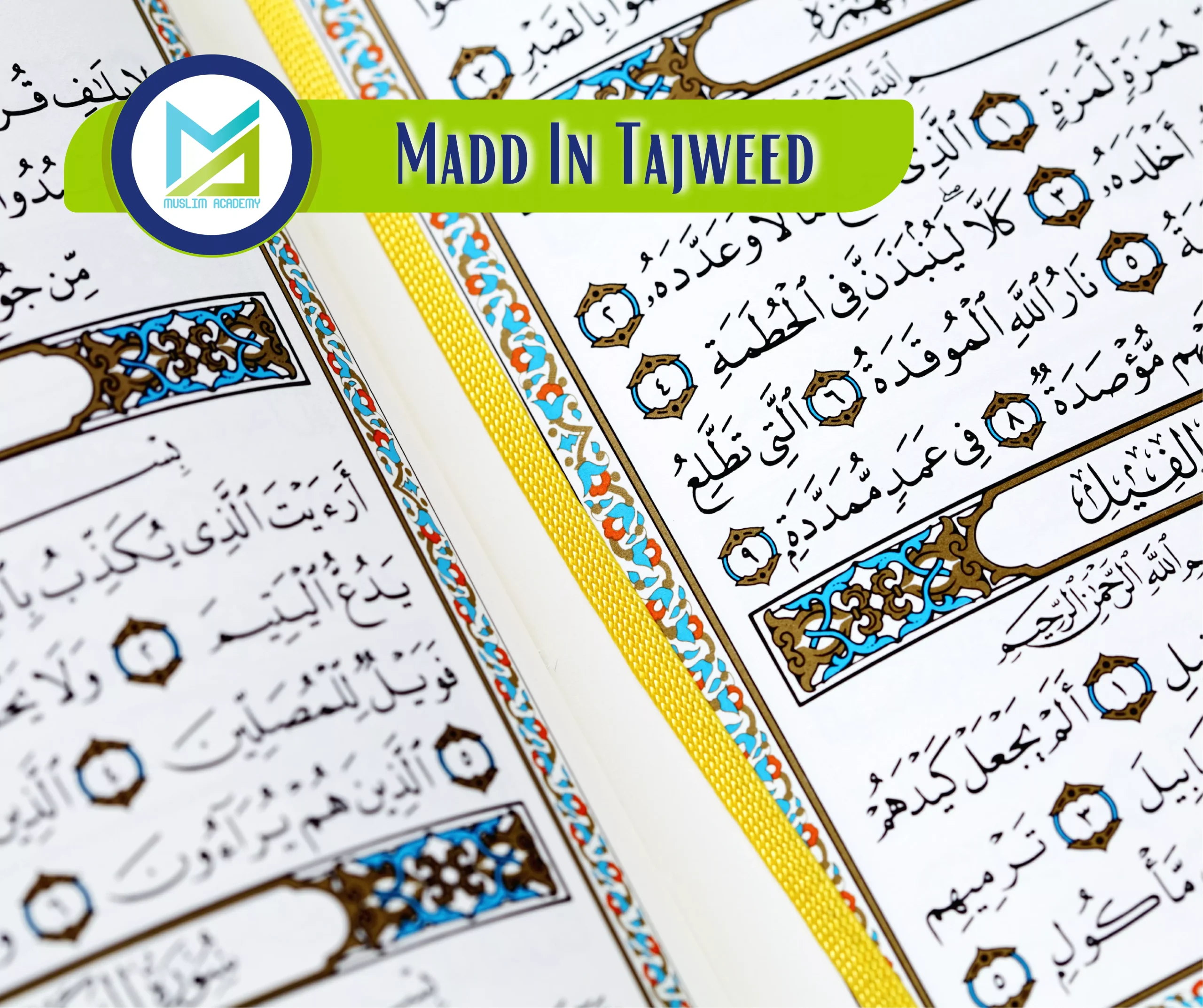
The concept of Madd In Tajweed with Muslim Academy represents one of the most essential and frequently encountered pronunciation rules governing proper Quranic recitation, determining how long certain vowel sounds should be extended to preserve meanings while creating the rhythmic beauty that characterizes expert vocalization. The Arabic term “madd” literally means “to stretch” or “to prolong,” describing the controlled elongation of specific vowel sounds beyond their natural short duration. This systematic regulation of vowel length proves crucial because Arabic is a duration-sensitive language where the difference between short and long vowels can completely alter word meanings, making precise elongation control essential for accurate textual transmission. Understanding when elongation applies, which duration each type requires, and how to maintain consistent timing elevates recitation from merely correct pronunciation to the measured, melodious delivery that honors divine revelation through both technical accuracy and aesthetic excellence.
Understanding the Foundational Concept
Madd occurs when specific letters—known as madd letters—appear in particular contexts requiring vowel sound prolongation beyond the brief articulation characterizing ordinary short vowels. The three madd letters are alif following fatḥah (creating the long “ā” sound), yā’ following kasrah (producing long “ī” sound), and wāw following ḍammah (generating long “ū” sound). When these letters appear, reciters must extend the vowel sound for specific durations measured in counts or beats rather than pronouncing them briefly like short vowels.
The timing precision that Madd In Tajweed with Muslim Academy requires reflects Islam’s emphasis on preserving Quranic recitation exactly as the Prophet Muhammad delivered it. Scholars have codified these duration requirements through centuries of oral transmission, documenting how long each elongation type should last to maintain authenticity with prophetic recitation. This meticulous attention to temporal precision ensures that contemporary Muslims recite identically to how the Quran has been vocalized across fourteen centuries of careful preservation.
Different types of madd exist, each governed by specific rules determining the exact elongation duration required. The context surrounding madd letters—what precedes them, what follows them, and whether the reciter pauses—all influence which madd type applies and consequently how long the vowel sound should extend.
Natural Madd: The Foundational Type
Natural madd (madd ṭabī’ī) represents the basic elongation occurring whenever madd letters appear without special conditions requiring extended duration. This foundational type lasts exactly two counts—a brief but clearly audible extension distinguishing long vowels from their short counterparts.
For example, when the word “قَالَ” (qāla, meaning “he said”) appears, the alif following the qāf with fatḥah creates natural madd. The reciter pronounces “qā”, extending the vowel sound for two counts before articulating the final “la.” This brief elongation differentiates “qāla” from hypothetical “qala” with a short vowel, demonstrating how duration affects meaning in Arabic’s vowel-length-sensitive phonology.
Natural madd forms the baseline against which other madd types are measured. When Tajweed rules specify that certain conditions require elongation lasting four, five, or six counts, these measurements reference the two-count natural madd as the standard unit.
Connected Madd: Context-Dependent Elongation
Connected madd (madd muṭṭaṣil) occurs when madd letters are followed by hamzah (the glottal stop sound ء) within the same word. This juxtaposition of madd letter and hamzah requires elongation extending beyond the natural madd’s two counts, typically lasting four or five counts, depending on the specific recitation tradition being followed.
The increased duration in connected madd reflects the phonetic relationship between extended vowel sounds and the subsequent glottal closure that hamzah represents. The elongation creates a smooth transition, managing the articulatory challenge of moving from a prolonged vowel directly into a glottal stop without abrupt harshness.
For instance, in the word “جَاءَ” (jā’a, meaning “he came”), the alif followed immediately by hamzah creates connected madd. The reciter extends “jā” for four or five counts before producing the hamzah, creating the characteristic elongated pronunciation that this rule mandates.
Separated Madd: Elongation Across Word Boundaries
Separated madd (madd munfaṣil) applies when a madd letter ending one word is followed by hamzah beginning the next word. This cross-word elongation typically lasts two, four, or five counts, depending on recitation style preferences, with different valid traditions permitting varying durations within established parameters.
The flexibility in separated madd duration reflects scholarly recognition that when Hamzah appears in a separate word, the phonetic connection differs from the tighter relationship in connected madd, where both elements occur within single words. Reciters may choose shorter or longer durations within permissible ranges based on their specific training tradition and stylistic preferences.
Obligatory Madd: Maximum Elongation
Obligatory madd (madd lāzim) represents the longest regular elongation type, requiring a fixed duration of six counts without variation. This maximum extension occurs in specific contexts, including when madd letters are followed by sukoon or shaddah within the original word structure, creating distinctive, prolonged pronunciations marking these relatively uncommon situations.
The six-count duration for Madd In Tajweed with Muslim Academy of this type creates particularly noticeable elongation that listeners immediately recognize as special emphasis marking unusual phonetic combinations. The extended duration ensures these contexts receive clear, unambiguous pronunciation, preventing any potential confusion about letter sequences or word structures.
Different subcategories of obligatory madd exist based on whether the triggering sukoon or shaddah appears within words (madd lāzim kilmī) or across word boundaries in connected reading (madd lāzim ḥarfī). Each subcategory maintains the six-count duration while occurring in distinct structural contexts that students must learn to recognize.

Madd Due to Sukoon: Flexible Elongation
When madd letters are followed by temporary sukoon—sukoon that appears due to pausing rather than being inherent to word structure—a special madd type applies, allowing flexible duration of two, four, or six counts. This variability gives reciters appropriate options for different pause contexts, enabling natural-sounding stops without rigid uniformity that might feel artificial.
The flexibility in this model type acknowledges that pausing serves various purposes with different emphases. Brief pauses for quick breaths might employ shorter durations, while significant pauses marking major thematic transitions might use maximum elongation, creating more definitive separation between sections.
Replacement Madd: Compensation for Hamzah
Replacement madd (madd badal) occurs in specific situations where hamzah
has been replaced by or converted into a madd letter according to Arabic
morphological rules. This madd type of madness typically receives a natural duration of
two counts, though some contexts permit optional elongation to four or five counts.
Understanding replacement madd requires recognizing the morphological
transformations that Arabic word formation sometimes applies to hamzah,
knowledge that builds gradually through exposure to numerous examples
rather than being immediately obvious to beginning students.
Measuring Duration Accurately
Consistent timing proves essential for proper Madd application. The counts
measuring elongation duration correspond roughly to finger snaps or beats at
moderate tempo—not rushed but not excessively slow. Students practice
maintaining a steady internal rhythm, enabling consistent elongation regardless of which madd type applies.
Common timing errors include rushing elongations so they barely exceed short
vowel duration, or conversely, exaggerating them beyond required counts,
creating theatrical pronunciation lacking natural flow. Proper madd strikes a
balance between clearly audible elongation and natural-sounding rhythm that doesn’t draw disproportionate attention.
Recording practice sessions and comparing with expert reciters helps students
calibrate their timing, as objective playback reveals whether durations match
required standards that subjective self-assessment during active recitation might miss.
Pedagogical Strategies for Mastery
Teaching Madd effectively combines theoretical explanation with extensive
practical application. Visual aids showing Madd letter identification, charts
listing different types with their duration requirements, and color-coded texts
highlighting Madd contexts all support learning.
Repetitive drilling of specific examples builds automaticity where students
recognize madd contexts instantly and apply correct durations automatically
without conscious counting that would disrupt reading flow. Progressive
complexity sequences introduce natural Madd first before advancing to
connected, separated, and obligatory types as foundational skills stabilize.
Audio immersion through regular listening to expert reciters trains students’
ears to recognize proper timing, creating internal models that guide their own
pronunciation attempts. This passive exposure complements active practice by
developing an intuitive sense of correct duration that supplements explicit rule knowledge.
Conclusion
Mastering Madd in Tajweed with Muslim Academy through understanding its
various types, recognizing contexts triggering different durations, and
developing consistent timing precision represents an essential competency for
proper Quranic recitation. From natural Madd’s foundational two-counts
through obligatory Madd’s maximum six-count extension, each elongation type
serves specific purposes, preserving pronunciation authenticity while
contributing to the rhythmic beauty characterizing expert vocalization.
Through dedicated study, extensive practice, and careful attention to timing
details, students develop the controlled elongation skills that distinguish
technically accurate recitation honoring divine revelation through both precision and aesthetic excellence.