Start Online Quran Classes with Muslim Academy
https://muslimacademy.net/index.php/free-trial/
The Quran is not simply a text to be read. It is a living recitation — a divine sound that has moved through mosques, homes, and hearts for more than fourteen centuries. From the very first moment of its revelation, God intended the Quran to be heard, spoken, and carried with precision and beauty. This is exactly where Al Quran Tajweed with Muslim Academy enters the picture.
Tajweed provides the complete set of rules that govern how Muslims recite the Quran. It ensures that every letter reaches the listener correctly, that every sound carries its full meaning, and that the reciter delivers the sacred text exactly as the Prophet Muhammad delivered it. Moreover, Tajweed is not a technical exercise reserved for scholars alone. Instead, it is a spiritual discipline that connects every Muslim — regardless of language or background — to a centuries-old tradition of love and reverence for the divine word.
What Tajweed Means and Why It Matters
The word “Tajweed” comes from the Arabic root j-w-d. In essence, it means doing something with excellence, beautifying it, and bringing it to its highest possible standard.
When applied to Quranic recitation, Tajweed means giving each letter its complete right. The reciter must produce every letter from its correct point of origin, apply the right sound quality to it, and follow the rules of elongation and pausing with full accuracy. Furthermore, the importance of Tajweed extends well beyond beauty alone. Arabic carries sounds where even a subtle mispronunciation can shift the meaning of a word entirely. As a result, Tajweed acts as a protective shield — preserving the Quran in its spoken, living form just as carefully as the written page preserves it in ink.
The Historical Roots of This Sacred Discipline
Tajweed as a formal discipline carries deep historical roots, though its principles stretch far beyond any written text. In the earliest days of Islam, teachers did not write down the rules of recitation — because oral transmission made that unnecessary. The Prophet Muhammad received the Quran from the Angel Jibreel with precise and specific pronunciation, and he then passed it on to his companions with the same careful attention.
However, as Islam spread rapidly to communities that spoke different native languages, the risk of mispronunciation grew significantly. Consequently, scholars stepped forward and began documenting the rules of recitation in a systematic way. By the 10th century, the science of Tajweed had taken full shape, and dedicated teachers across the Islamic world carried it forward with remarkable devotion. Today, students of Tajweed continue to benefit from that long and unbroken tradition of scholarly care.
The Points of Articulation in Arabic Recitation
One of the most essential foundations of Al Quran Tajweed with Muslim Academy is the concept of Makhaarij al-Huroof — the precise points in the mouth and throat from which each Arabic letter originates.
Arabic contains sounds that most other languages simply do not include. Producing these sounds correctly requires the reciter to place the tongue, lips, throat, and nasal cavity in very specific positions. Scholars of Tajweed identified seventeen distinct articulation points across the human vocal system, ranging from the depths of the throat to the edges of the lips.
Therefore, a student must first learn to produce each letter from its correct point of origin before moving forward with any other rule. Without this foundation, even a melodically pleasing recitation falls short of true Tajweed. Correct articulation is not an advanced skill — it is the very starting point of the entire journey.
The Characteristics That Shape Each Letter
In addition to articulation points, Tajweed also addresses the natural characteristics that belong to each Arabic letter. Scholars call these qualities Sifaat al-Huroof, and they shape the personality of every sound in the Quran.
Some letters carry heaviness and fill the mouth with resonance. Others flow lightly and with minimal friction. Certain letters hold an echo that lingers briefly after the tongue releases them, while others cut off sharply and immediately. Some require the reciter to stop the breath entirely at the point of articulation, while others allow the sound to continue flowing forward.
Importantly, these characteristics are not decorative additions. They belong to each letter naturally, and pronouncing a letter with the wrong characteristic effectively changes its identity. As a result, mastering the Sifaat transforms a technically accurate recitation into one that truly honors the full richness of the Arabic sound system.
Noon and Meem: The Rules of Nasalization
Among the most carefully studied areas in Tajweed, the rules governing the letters Noon and Meem deserve special attention. These rules apply particularly when these letters carry a sukoon — a state of rest — or appear in their doubled form known as Shaddah.
The rules of Ghunnah, Idghaam, Ikhfaa, and Iqlaab all describe how these two letters interact with the letters that immediately follow them. For instance, when Noon encounters certain letters, the reciter fully merges it into the following sound. In other cases, the reciter conceals it behind a gentle nasal hum. In still other cases, the letter transforms into a Meem sound altogether. Each of these changes follows a clear and well-documented pattern. Far from being arbitrary, these transformations reflect the natural flow of Arabic speech and give Quranic recitation much of its recognizable musical quality.
The Art of Madd: Elongation and Its Levels
Madd refers to the deliberate elongation of vowel sounds during recitation. Skilled reciters use it to shape the rhythm, pacing, and emotional impact of every passage they deliver.
Arabic vowels extend for varying durations, and scholars measure these durations in units called Harakaat. Tajweed specifies exactly how long a reciter must hold each elongation, based on the specific letters and conditions present at that point in the text. Some forms of Madd are obligatory, meaning the reciter must hold them for a set count. Others are permissible, offering some room for individual style. Still others are natural and brief.
Mastering Madd demands both intellectual understanding and physical discipline. Specifically, the reciter must sustain a controlled, steady breath while keeping the tone clear and beautiful throughout the full length of every elongation. This skill develops gradually over time and reflects real dedication to the art.
Stopping and Starting: The Science of Waqf
Knowing exactly where to pause and where to continue forms another vital pillar of Al Quran Tajweed with Muslim Academy. Scholars refer to this area as Waqf — the science of stopping and resuming during recitation.
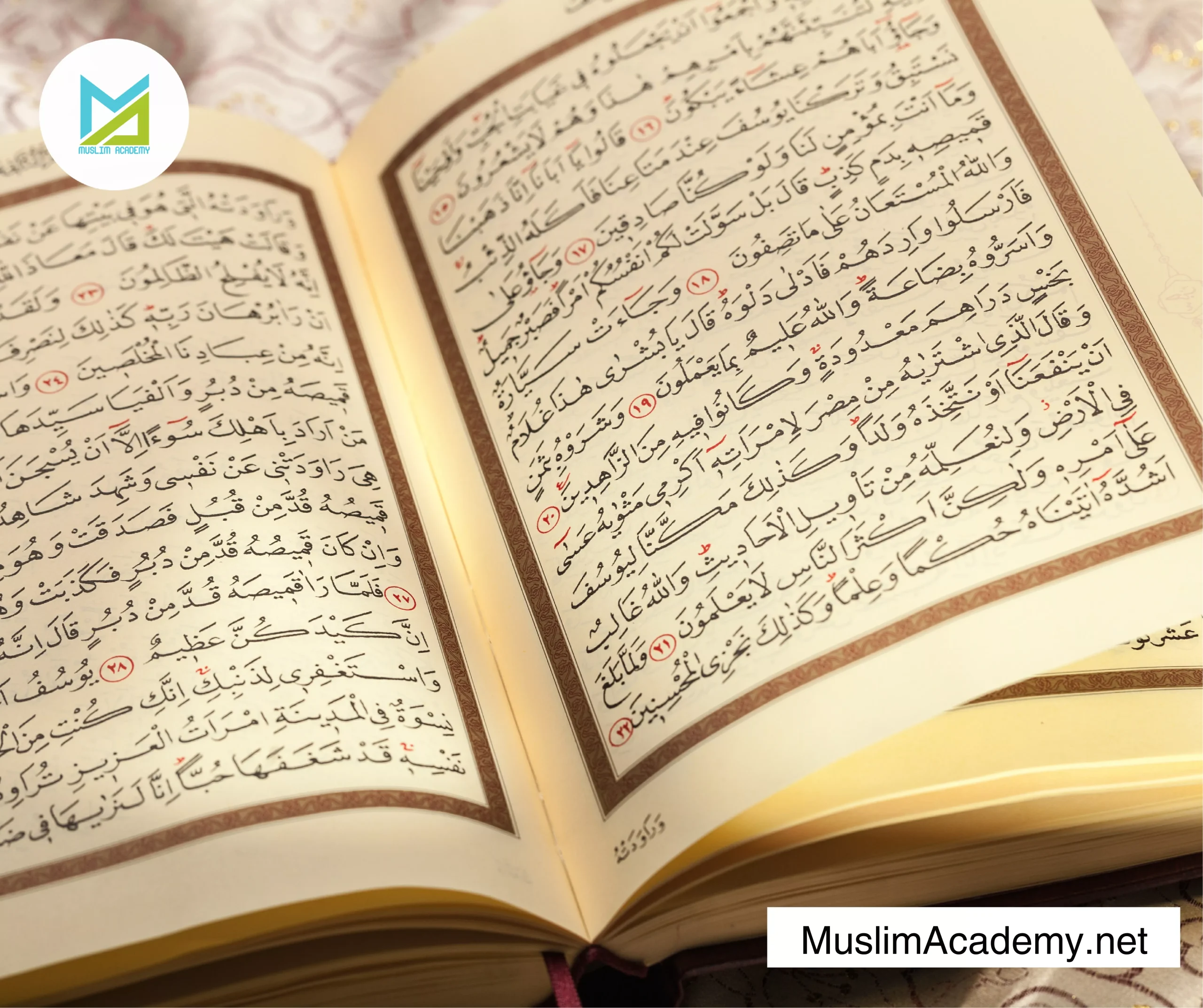
Stopping at the wrong point in a verse can seriously distort its meaning or leave a sentence hanging misleadingly. By contrast, stopping at the right moment allows the listener to absorb the verse fully before the reciter moves forward. To help reciters navigate these decisions, the Quran carries a clear system of symbols that mark where a full stop is recommended, where pausing is permissible, where continuing is preferred, and where stopping would be inappropriate. Learning to read and apply these markings ensures that every verse reaches its listener with the meaning and impact it deserves.
The Role of the Teacher in Preserving Oral Transmission
No textbook, however detailed, can fully replace a living teacher in the world of Tajweed. This fact reflects one of the most remarkable features of the Quranic tradition — it has always traveled from mouth to ear, from teacher to student, through an unbroken human chain stretching directly back to the Prophet Muhammad.
Scholars call this chain Isnad. Serious students of Tajweed can actually trace their line of teachers back through documented history, generation by generation. When a student sits before a qualified teacher, they do not simply receive information. Rather, they join a living line of transmission that connects them personally to the original moment of revelation. This relational and human dimension of learning gives Tajweed a spiritual weight and beauty that no written resource can fully replicate.
Tajweed as a Spiritual Practice, Not Just a Technical Skill
Many people approach Tajweed as a technical discipline and nothing more. In reality, however, sincere Muslims experience it as a deeply personal act of worship.
When a reciter slows down to apply a rule with care, gives each letter its complete measure, and pauses at precisely the right moment, they are practicing a form of mindfulness that keeps the heart fully present with the divine word. Additionally, the physical act of shaping the Quran’s sounds with the body — through the breath, the tongue, and the throat — becomes itself a form of remembrance. Many experienced reciters describe the feeling of reciting with true Tajweed as one of the most spiritually grounding experiences in their entire religious life. Clearly, Tajweed reaches far beyond technique and into the realm of the soul.
A Living Tradition That Belongs to Every Muslim
Some people assume that Tajweed belongs only to professional reciters or advanced religious scholars. In truth, however, it belongs to every single Muslim who opens the Quran.
Every person who recites even one verse carries the responsibility of doing so as accurately as they possibly can. Scholars have always distinguished between the obligation to learn Tajweed and the expectation of perfect mastery, making clear that sincere, consistent effort is what truly matters. For example, a new Muslim who struggles to produce unfamiliar Arabic sounds is still fulfilling a noble obligation, and the tradition honors that effort fully. Therefore, Tajweed is not a barrier standing between the reader and the Quran. On the contrary, it is a welcoming doorway — one that opens into a richer, deeper, and more intimate encounter with the word of God across fourteen centuries of unbroken human devotion.
Conclusion
The science and practice of Al Quran Tajweed with Muslim Academy stands as one of the most extraordinary traditions of care and scholarship in all of human civilization. It reflects a community’s enduring commitment to carrying the sound of the divine word forward with the same precision that scholars apply to the written text.
From the rules of articulation to the levels of elongation, from the science of pausing to the living teacher-student chain — Tajweed holds within it a world of precision, beauty, and spiritual purpose. Whether someone has studied the Quran for decades or is just beginning the journey, engaging with Tajweed offers an invitation to approach the sacred text with deeper awareness, genuine humility, and a lasting appreciation for the extraordinary human effort that has kept it alive — across centuries, across languages, and across the full breadth of human experience.