
Start Online Quran Classes with Muslim Academy
https://muslimacademy.net/index.php/free-trial/
When a Muslim opens the Quran, they do not simply open a book. They open a conversation with the divine — a text that God chose to preserve in its original language, in its original sound, and with its original precision across more than fourteen centuries of human history. This extraordinary act of preservation makes one thing absolutely clear: the words of the Quran matter, the sounds matter, and the way a person delivers those sounds matters profoundly. This is precisely why scholars, teachers, and communities across the entire Muslim world consistently emphasize the same essential guidance — Read Quran With Tajweed with Muslim Academy.
Tajweed is the science that governs how each letter of the Quran should be produced, how sounds interact with one another, how long specific vowels should be held, and where the reciter should pause or continue. It is not a decorative layer applied on top of the Quran’s meaning — it is the very framework within which the Quran’s sounds live and breathe. Furthermore, Tajweed is not reserved for professional reciters or religious scholars. Every Muslim who engages with the Quran carries the responsibility of applying its rules as accurately as they are able, and every sincere effort in that direction earns genuine spiritual merit.
What It Truly Means to Read With Tajweed
Many students hear the word “Tajweed” and imagine something reserved for advanced learners — a refinement that ordinary Muslims can appreciate from a distance but need not pursue personally. This impression misrepresents the tradition entirely. Classical scholars consistently taught that applying Tajweed during recitation is an obligation for every Muslim, not an optional enhancement for specialists.
To read the Quran with Tajweed means to give every letter its complete right. It means producing each sound from its correct point of articulation in the mouth or throat, applying the characteristic qualities that belong naturally to each letter, observing the rules of elongation and nasalization precisely, and pausing at the moments the text requires rather than wherever breath or convenience dictates. Furthermore, it means approaching the act of recitation with conscious attention — treating every word as deserving of the care and precision that a message from God genuinely demands. Consequently, Tajweed transforms recitation from a routine verbal exercise into a mindful and deeply intentional act of worship.
The Articulation Points That Form the Foundation
Before a student can apply any advanced rule of Tajweed, they must first master the foundation — the precise points in the mouth and throat from which each Arabic letter originates. Scholars call these points Makhaarij al-Huroof, and they identify seventeen distinct articulation positions across the human vocal system.
Arabic carries sounds that most other languages simply do not include. Several letters originate deep in the throat, producing sounds that require the reciter to engage muscles they rarely activate when speaking their native language. Others form at specific points on the tongue, the teeth, or the lips, each requiring a slightly different placement to produce correctly. Therefore, a student who dedicates genuine effort to learning the articulation points builds the most essential layer of their Tajweed practice. Without this foundation, every other rule floats without an anchor — technically understood but practically incomplete.
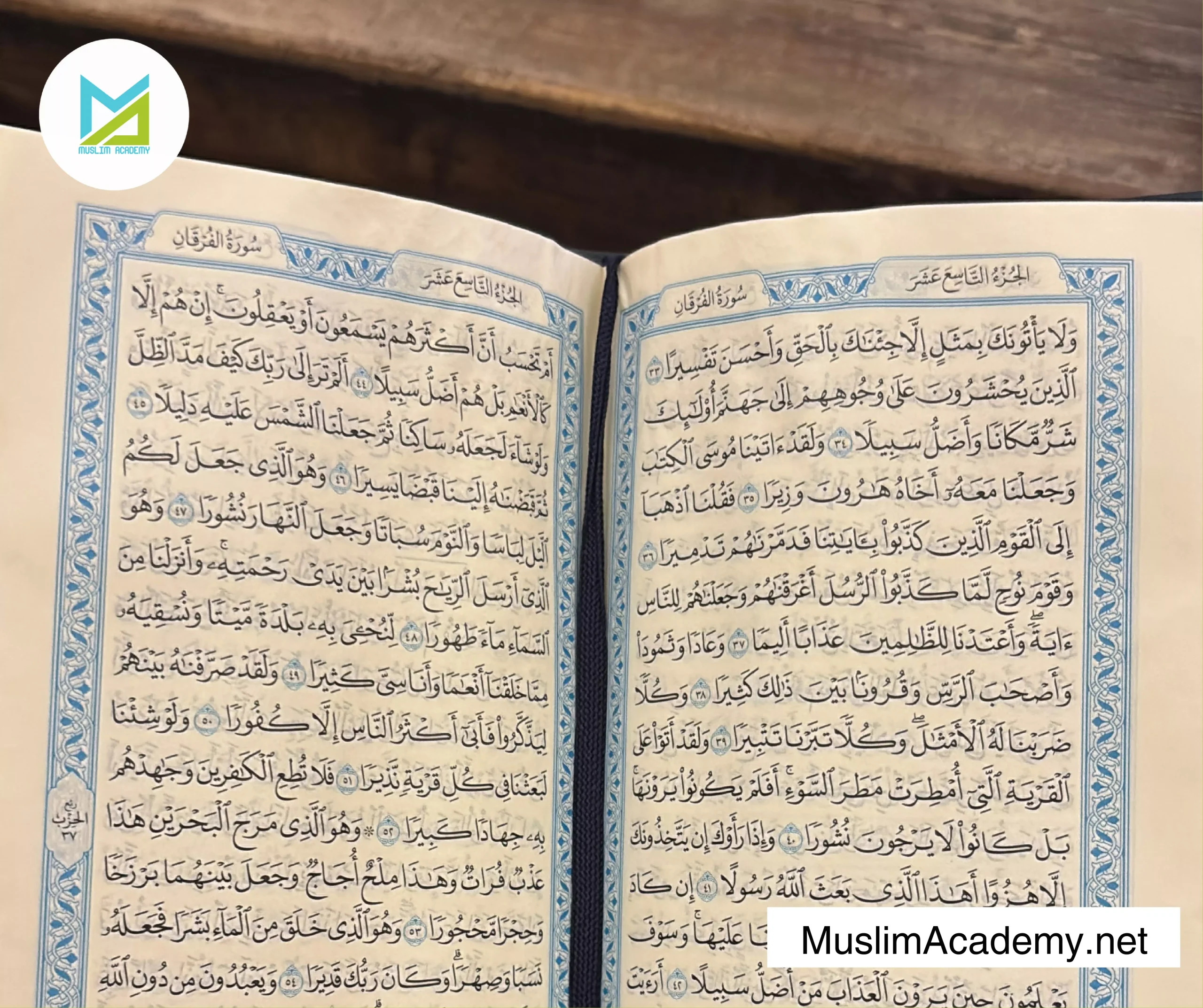
The Natural Characteristics of Arabic Letters
In addition to knowing where each letter originates, a student who wants to Read Quran with Tajweed with Muslim Academy must also understand the natural characteristics that belong to each letter — qualities scholars call Sifaat al-Huroof. These characteristics shape the personality of every sound and determine how the reciter produces it beyond the basic point of articulation.
Some letters carry heaviness, filling the mouth with a full, rounded resonance when pronounced correctly. Others carry lightness, flowing forward with minimal weight. Certain letters hold a brief echo after the tongue releases them. Others cut off sharply and completely. Some require the breath to stop entirely at the moment of articulation, while others allow the sound to continue flowing naturally. Importantly, these qualities are not stylistic choices — they belong inherently to each letter, and applying the wrong characteristic effectively changes the letter’s identity. Moreover, mastering these qualities gives a recitation a natural richness and texture that listeners immediately recognize as genuine and carefully crafted.
The Rules of Noon and Meem
Among the most studied dimensions of Tajweed, the rules governing the letters Noon and Meem when they appear without a vowel deserve particular attention from every student. These rules determine how these two letters interact with the letters that immediately follow them, and applying them correctly gives recitation much of its characteristic musical flow.
When Noon without a vowel meets specific letters, the reciter merges it completely into the following sound in a rule called Idghaam. When it meets the letter Ba, the reciter converts it into a Meem sound in a rule called Iqlaab. When it meets certain other letters, the reciter conceals it behind a gentle nasal hum in a rule called Ikhfaa. In all remaining cases, the reciter pronounces it fully and clearly in a rule called Idhar. Furthermore, the letter Meem carries its own parallel set of rules — merging, concealing, or pronouncing clearly depending on the letter that follows it. Consequently, mastering these rules gives the student confident and accurate control over two of the most frequently occurring letters in the entire Quran.
Madd: The Elongation That Shapes Rhythm and Beauty
Madd — the deliberate lengthening of specific vowel sounds — plays a central role in Tajweed and contributes enormously to the rhythm and emotional depth of Quranic recitation. Scholars measure these elongations in units called Harakaat, and Tajweed specifies precisely how many counts each type of Madd requires based on the letters and conditions present at that point in the text.
Natural Madd extends for exactly two counts in all cases and forms the baseline of elongation practice. Secondary Madd responds to specific triggering conditions — the presence of a Hamzah, a Shaddah, or a sukoon at a pause point — and extends for four or six counts depending on the precise rule involved. Furthermore, some forms of secondary Madd offer the reciter a degree of flexibility, allowing individual style to emerge within established boundaries. Therefore, mastering Madd demands both intellectual understanding of the rules and physical training of the breath — developing the ability to sustain a controlled, clear tone across the full duration of every elongation with consistency and beauty.
Ghunnah and the Nasal Resonance of Tajweed
Ghunnah refers to the nasal resonance that the letters Noon and Meem carry in specific circumstances — a warm, humming sound that originates in the nasal cavity and adds a distinctive quality to recitation that listeners immediately recognize. Scholars measure Ghunnah at approximately two counts in duration, and they identify it as an obligatory feature whenever these letters appear with a Shaddah or in the cases of Idghaam, Ikhfaa, and Iqlaab.
Producing Ghunnah correctly requires the reciter to allow sound to resonate through the nasal passage while maintaining the correct mouth position for the letter involved. Furthermore, the reciter must sustain the nasal resonance for its full duration without shortening it out of haste or extending it beyond its prescribed limit. As a result, Ghunnah adds a layer of warmth and musicality to recitation that represents one of Tajweed’s most recognizable and beautiful features — a quality that experienced listeners can identify immediately in any reciter who applies it well.

The Science of Pausing: Waqf and Ibtidaa
Knowing exactly where to stop and where to continue represents one of the most practically significant aspects of the effort to Read Quran with Tajweed with Muslim Academy. Scholars call this science Waqf and Ibtidaa — the rules of pausing and resuming —, and it shapes the meaning and impact of every recited passage far more powerfully than many students initially recognize.
Stopping at the wrong point in a verse can cut a sentence in half, leave a
meaning dangling, or — in the most serious cases — create the impression of a
meaning that the verse does not actually carry. By contrast, stopping at the
right moment allows each verse to deliver its full weight and allows the listener
to absorb its meaning before the recitation moves forward. The Quran carries a
detailed system of symbols that guide the reciter at every step — marking full
stops, permissible pauses, preferred continuation points, and locations where
stopping would be inappropriate. Therefore, a student who learns to read and
respect these markers demonstrates a level of care for the Quran’s meaning that reflects genuine mastery of the recitation art.
Learning From a Qualified Teacher
No book, recording, or digital platform — however excellent — can fully replace
the experience of learning Tajweed from a qualified human teacher. Tajweed is
fundamentally an oral tradition. It travels from mouth to ear, from teacher to
student, through a chain of transmission that reaches back without
interruption to the Prophet Muhammad himself.
A qualified teacher brings to every lesson the ability to hear a student’s
recitation in real time and identify errors that the student cannot hear in their
own voice. They correct pronunciation immediately, model the correct sound
repeatedly, and adjust their explanations to match the specific difficulties each
student encounters. Furthermore, they provide the accountability and
encouragement that sustain a student through the challenging periods that
every serious learner faces. Consequently, a student who combines regular
sessions with a qualified teacher with daily personal practice creates the ideal conditions for genuine and lasting progress in Tajweed.
Building a Daily Practice That Produces Real Progress
Understanding Tajweed rules intellectually is only the beginning. Translating
that understanding into confident, accurate recitation demands daily practice
— consistent, focused, and sustained over months and years rather than days
and weeks. Many students underestimate this dimension of the journey and
feel discouraged when knowledge of the rules does not immediately translate
into smooth and natural recitation. This gap between knowing and doing is
entirely normal, and patience with it is itself a part of the practice.
Successful students build their Tajweed practice into a fixed daily routine and
protect that routine with genuine commitment. They select a short passage
and work through it slowly, applying each rule deliberately until the correct
production begins to feel natural. Furthermore, they listen regularly to expert
reciters — absorbing correct Tajweed through the ear as well as the intellect,
allowing the sounds to shape their own vocal habits over time. Additionally,
they approach their mistakes with curiosity rather than frustration, treating
each correction as an opportunity to deepen their understanding rather than
evidence of inadequacy. Therefore, daily practice pursued with patience and
genuine intention produces the kind of real and durable progress that transforms a student’s recitation over time.
The Spiritual Reward of Reading With Precision and Care
Beyond the technical and linguistic dimensions, the effort to Read Quran with
Tajweed with Muslim Academy carries a spiritual significance that motivates
countless Muslims to invest years in its pursuit. The Prophet Muhammad
explicitly honored the effort of every Muslim who struggles with the Quran’s
recitation — stating that the one who recites with difficulty while striving to
improve earns a double reward. This teaching transforms every session of
Tajweed practice into an act of worship, regardless of the student’s current level of mastery.
Moreover, many Muslims who commit seriously to Tajweed describe a
transformation in their relationship with the Quran that extends far beyond
the technical. When a reciter gives each letter its full measure, elongates each
vowel according to its rule, and pauses at the moments the text requires, they
develop a quality of attention and presence during recitation that they rarely
achieve in any other activity. The Quran begins to speak more directly, each
verse landing with greater clarity and weight. Consequently, Tajweed serves
not only the accuracy of the recitation but the depth of the encounter with the
divine word — drawing the reciter into a more intimate and more genuine
relationship with the text they carry in their voice and their heart.
Conclusion
The commitment to Read Quran With Tajweed with Muslim Academy is
ultimately an expression of love — love for the word of God, respect for the
tradition that preserved it, and a genuine desire to honor the text with every
breath the reciter brings to it. It demands patience, consistency, and a
willingness to remain a student for as long as the journey requires. However,
Every step of progress along this path carries its own reward — a deeper
connection to the Quran, a more accurate transmission of its sounds, and a
living participation in a tradition of care and devotion that has sustained the
Muslim community for over fourteen centuries.
Whether a person is just beginning to learn the Arabic letters or has recited
The Quran daily for decades, Tajweed always offers something more to
discover, something more to refine, and something more to offer back to the
text that has given so much to every generation that has loved it.