Start Online Quran Classes with Muslim Academy
https://muslimacademy.net/index.php/free-trial/
Every Muslim who recites the Quran has heard the word Tajweed. It appears in every discussion of Quranic education, every recitation course, and every conversation about how to honor the sacred text through the voice. Yet many learners begin their journey without a clear understanding of what Tajweed actually is and what it requires of them. Knowing what Tajweed means with Muslim Academy is therefore the essential first step for any student who wants to recite the Quran correctly, beautifully, and in a manner consistent with the tradition the Prophet Muhammad established. Furthermore, Tajweed is not simply a collection of technical rules — it is a complete approach to honoring divine speech with every breath and every sound the human voice produces. This article explores the meaning of Tajweed, its historical origins, its major components, and how any learner can begin applying it with confidence.
What Tajweed Means with Muslim Academy
The Arabic word tajweed comes from the root j-w-d, which carries the meaning of doing something excellently, making something good, or producing something of the highest quality. Consequently, when scholars say Tajweed means ” with Muslim Academy, they are pointing to something more than technical correctness. They are describing an orientation of the entire reciting self — voice, mind, and heart — toward the highest standard of engagement with the Quran.
In practical terms, Tajweed Means with Muslim Academy applying a defined set of rules that govern how every letter of the Arabic alphabet should sound, how vowels should be lengthened or shortened, how letters interact when they meet each other, and where the voice should pause and resume. Moreover, these rules are not human inventions applied to an already existing text. They preserve the precise manner in which the Quran was revealed to the Prophet Muhammad and transmitted through an unbroken chain of teachers and students across fourteen centuries. Furthermore, every qualified reciter alive today can trace their recitation back through that chain to the Prophet himself.
The Historical Origins
Tajweed, as a formal science, developed out of a practical necessity. As Islam spread beyond Arabia into Persia, Africa, Central Asia, and beyond, non-Arabic speakers began entering the faith in enormous numbers. Additionally, even among Arabic speakers, regional dialects threatened to introduce pronunciation habits that diverged from the precise sounds of Quranic revelation. Consequently, early scholars began codifying the rules of correct recitation that the companions had absorbed naturally through direct contact with the Prophet.
The first formal treatises on Tajweed appeared in the third and fourth Islamic centuries. Scholars such as Abu Ubaid Al-Qasim ibn Sallam and later Al-Dani contributed foundational works that systematized what had previously been transmitted only orally. Moreover, the ten recognized recitation styles of the Quran — each traced back through authenticated chains to the Prophet — were documented and preserved through this period of intensive scholarly activity. Therefore, the written science of Tajweed did not create something new. Rather, it documented and protected something ancient and irreplaceable.

The Major Components
Understanding what Tajweed means with Muslim Academy in practice requires familiarity with its core areas of concern.
Makhaarij Al-Huroof — Articulation Points
Every Arabic letter originates from a specific point in the mouth, throat, or nasal cavity. Furthermore, Arabic contains sounds that simply do not exist in most other languages. Letters such as Ayn, Ghain, Ha, Kha, and Qaf require precise physical placement that learners must develop through consistent practice. Producing a letter from the wrong articulation point changes its identity. In some cases, it changes the word entirely. Consequently, mastering articulation points is the first and most fundamental task of any Tajweed student.
Sifaat Al-Huroof — Characteristics of Letters
Beyond their articulation points, Arabic letters carry specific characteristics that shape how they sound in context. Some letters are heavy, producing a full and resonant sound. Others are light, remaining thin and clear. Some carry a vibration. Others require a complete stoppage of airflow before release. Moreover, certain characteristics belong permanently to a letter regardless of context. Others apply only under specific conditions. Additionally, understanding these characteristics allows the reciter to produce authentic Quranic sounds rather than approximations shaped by their native language habits.
Rules of Noon Saakin and Tanween
When a noon letter carries no vowel, or when a word ends with a double vowel sound, four distinct rules govern what follows. Idh-haar requires the noon to sound clearly and distinctly when it meets specific throat letters. Idghaam requires complete merging into the following letter. Furthermore, Iqlaab transforms the noon into a nasal Meem sound when it meets the letter Ba. Additionally, Ikhfaa produces a nasal sound held between clarity and full merging across a wide range of letters. Each of these rules appears repeatedly throughout the Quran. Therefore, mastering them is a practical priority for any serious student.
Rules of Madd — Elongation
Arabic distinguishes between short and long vowel sounds, and the Quran encodes these distinctions with great precision. Madd refers to the lengthening of specific vowel sounds according to fixed rules. Moreover, elongation is not a stylistic choice — it is a governed system with specific durations measured in units called harakaat. The basic Natural Madd requires two beats of elongation. Secondary forms extend this to four or six beats, depending on whether a hamzah or sukoon follows the long vowel letter. Consequently, applying elongation correctly shapes the entire rhythm and beauty of a recitation.
Heavy and Light Letters
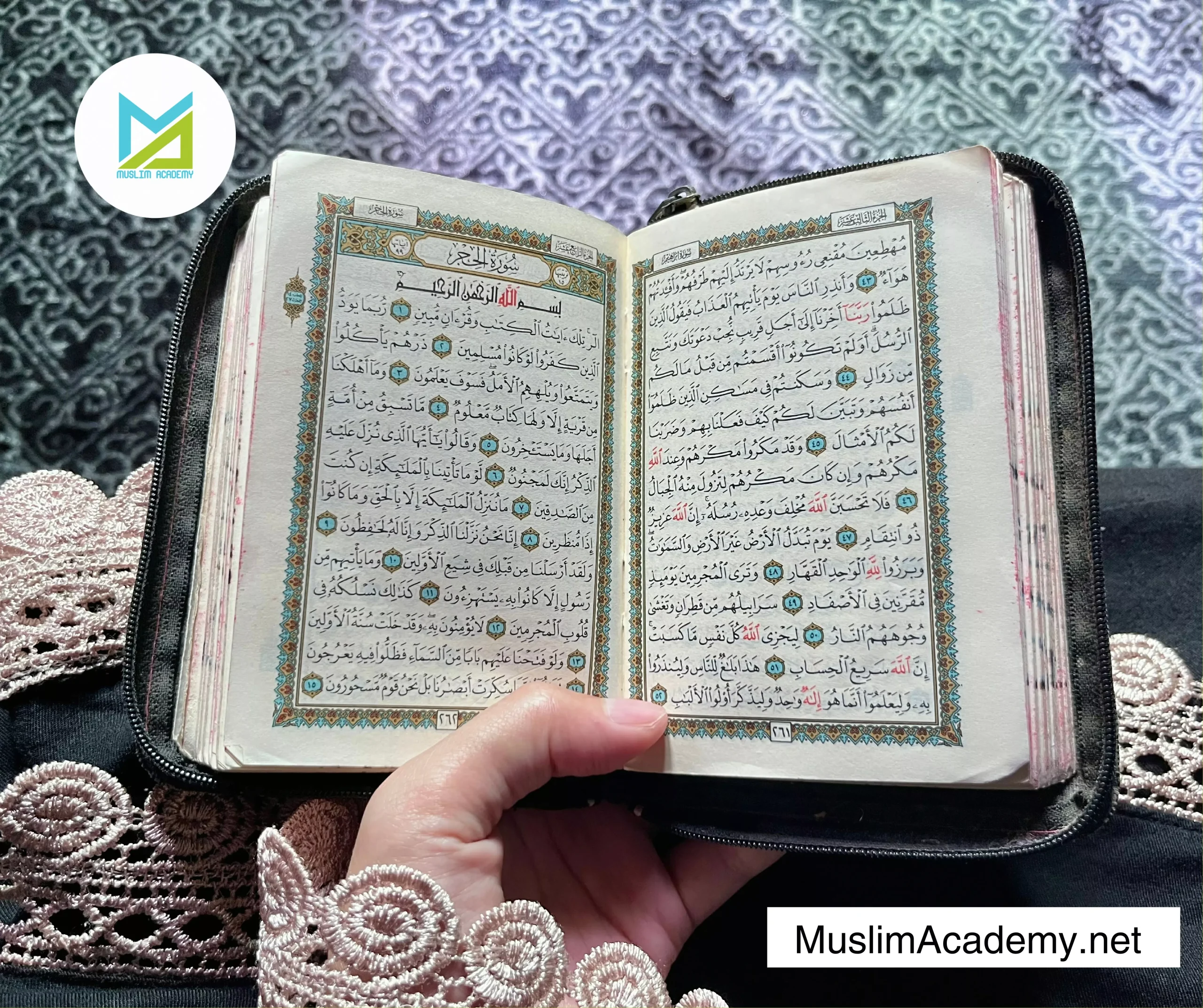
Arabic letters divide into heavy letters — those that produce a full, deep resonance — and light letters that remain thin and clear. Furthermore, applying the correct quality to each letter is among the most immediately noticeable features of skilled recitation. Heavy letters must receive their full depth. Light letters must remain thin. Allowing a heavy letter to sound light, or forcing a light letter to sound heavy, distorts the phonetic identity of the Quran in ways that careful listeners readily detect.
Rules of Pausing and Stopping
Knowing where to pause and where to continue is a practical and linguistically important Tajweed skill. Stopping at the wrong place can join ideas the text separates or separate ideas the text joins. Additionally, most standard Quran copies include symbols that guide the reciter — indicating mandatory stops, preferred pauses, permissible pauses, and places where stopping is discouraged. Moreover, when a reciter stops mid-verse for breath, specific rules govern how to handle the final word. Mastering these rules produces a recitation that flows naturally, preserves meaning, and honors the internal rhythm of the sacred text.
The Spiritual Dimension
Tajweed means with Muslim Academy more than technical compliance. Classical scholars consistently emphasized that the rules of Tajweed exist to serve a purpose that extends beyond phonetic accuracy. Every letter given its full articulation, every elongation held to its correct length, every pause falling in its right place — these acts together create the conditions for a recitation that honors the Quran as divine speech. Furthermore, a reciter who applies Tajweed with sincere intention is not merely performing a skill. They are fulfilling a form of worship — honoring the words of Allah with the best that the human voice can offer.
Additionally, the Quran itself commands that it be recited with tarteel — a measured, thoughtful, and carefully articulated delivery. Scholars have consistently understood this command as a direct reference to the principles that Tajweed preserves. Therefore, the pursuit of correct recitation is not optional for the believer who takes seriously the Quran’s own instruction about how it should be read.
How to Begin Learning
Understanding what Tajweed means with Muslim Academy is a starting point. Applying it requires a qualified human teacher. The sounds involved — their precise quality, articulation, and placement within the flow of recitation — cannot be fully learned from written descriptions alone. Moreover, the ear must be trained alongside the voice. Listening consistently to certified and skilled reciters builds intuitive recognition of correct sounds that no textbook can replicate.
Short, daily practice sessions consistently outperform long, infrequent ones. Furthermore, practicing with actual Quranic verses — rather than isolated examples — trains the student to apply rules within natural recitation flow. Combining teacher guidance, regular listening, and honest self-assessment produces steady and lasting improvement.
Conclusion
Tajweed Means with Muslim Academy excellence — excellence in sound, in care, and in the respect shown to every word of the Quran. Its rules are not obstacles to beautiful recitation. On the contrary, they are the very path through which beautiful recitation becomes possible. Every student who commits to learning them takes a step along a road that generations of Muslims have walked before them — a road that leads to a deeper, more accurate, and more spiritually alive engagement with the sacred text.