Start Online Quran Classes with Muslim Academy
https://muslimacademy.net/index.php/free-trial/
Every Muslim who prays recites the Quran. They stand before Allah and speak His words aloud. Yet many Muslims recite without truly knowing whether their pronunciation is correct. Some learned from parents who themselves learned informally. Others memorised sounds without understanding the rules behind them. This gap between intention and accuracy is one of the most common challenges in Muslim religious life.
The decision to learn Quran Recitation with Muslim Academy properly is one of the most rewarding commitments a Muslim can make. It transforms daily prayer. deepens the connection to the sacred text. It fulfils a religious obligation that every reciting Muslim carries. Furthermore, it connects the learner to a living tradition of oral transmission that has preserved the Quran with extraordinary precision for over fourteen centuries.
This guide explores what learning correct recitation actually involves, where to begin, and how to build a practice that lasts a lifetime.
What Correct Recitation Actually Means
Many people think correct recitation simply means reading Arabic without mistakes. In reality, it is far more precise than that. Correct Quranic recitation follows a comprehensive science called tajweed. This science governs every sound in the Quran. It covers the articulation point of each Arabic letter. It addresses vowel duration, letter characteristics, and the rules for connecting adjacent sounds.
The word tajweed means to do something with excellence. Applied to the Quran, it means giving each letter its full right — producing it from the correct point in the mouth or throat, with the correct qualities, for the correct duration. Furthermore, it means applying specific rules when certain letters meet each other. These rules determine whether sounds merge, lengthen, nasalise, or stop.
This level of precision exists for an important reason. The Quran was revealed in Arabic. Its meaning is inseparable from its sound. A single mispronounced letter can change a word’s meaning entirely. Consequently, Muslims have always regarded correct recitation as a religious duty — not an optional refinement for advanced students.
Why a Qualified Teacher Is Essential
Many Muslims attempt to improve their recitation through self-study. They listen to recordings. Watch videos. Read books explaining the tajweed rules. All of these resources have genuine value. However, none of them can replace a qualified teacher.
The reason is straightforward. A student cannot hear their own pronunciation errors. The sounds they produce feel correct to them. They match the internal template the student has built through years of incorrect habits. Only a trained external ear — a teacher who listens carefully and knows precisely what to listen for — can identify these errors accurately.
Moreover, Arabic contains sounds that most non-Arab speakers have never produced before. Letters that originate deep in the throat. that require the tongue to touch specific points on the palate. that produces a ringing resonance or a complete stop of airflow. Learning to produce these sounds correctly requires demonstration, feedback, and guided repetition. A recording can model the sound. Only a live teacher can assess whether the student is reproducing it.
Furthermore, a certified Quran teacher carries an ijaza — a formal authorisation that links their recitation to the Prophet Muhammad through an unbroken chain of scholars. When a student learns from such a teacher, they enter that chain. Their recitation connects to the same tradition that has preserved the Quran’s sounds across fourteen centuries.

The Journey to Learn Quran Recitation with Muslim Academy
The path to correct Quranic recitation follows a clear and logical sequence. Each stage builds directly on the one before it. Skipping stages produces weak foundations. Moving steadily through each one produces a durable, accurate recitation.
Stage One: The Arabic Alphabet
Every journey begins here. A student who cannot read Arabic letters accurately cannot recite correctly. This stage covers letter recognition, correct sound production, and reading letters in connected script. Many teachers use the Noorani Qaida — a carefully structured reading primer — to guide students through this foundation. Patience at this stage prevents errors that become extremely difficult to correct later.
Stage Two: Basic Reading With Vowels
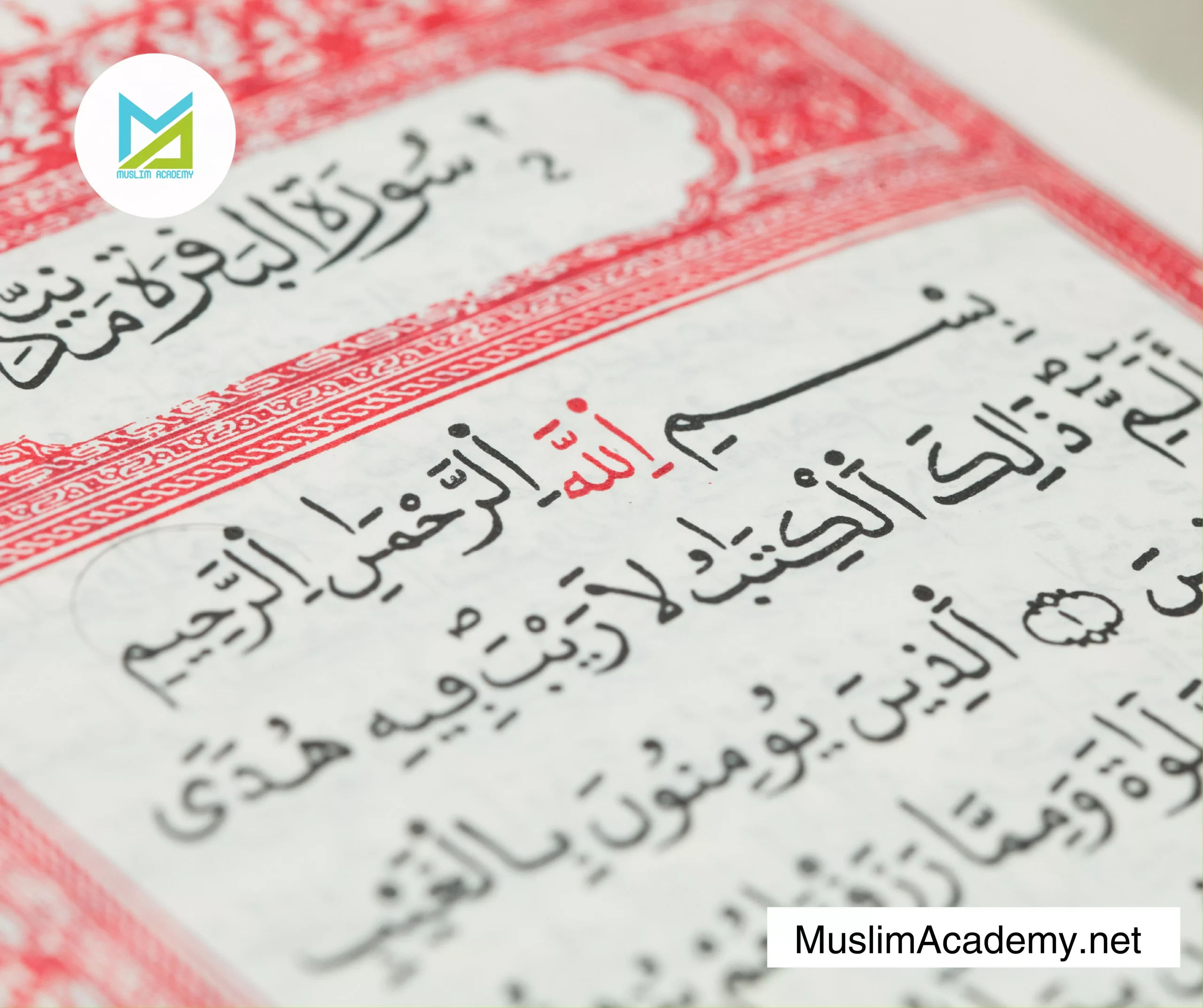
Arabic script in the Quran carries vowel markers — small symbols above and below the letters that indicate precise vowel sounds. Learning to read these markers accurately transforms a student from someone guessing at pronunciation to someone reading the text as written. This skill is essential. Without it, correct recitation is impossible, regardless of how many tajweed rules a student knows theoretically.
Stage Three: Tajweed Rules
Once a student reads Arabic fluently, the focus shifts to applying the tajweed rules in real Quranic text. A qualified teacher introduces each rule systematically. They apply it immediately to actual Quranic verses. Students practice the rule under the teacher’s supervision. Errors receive immediate, precise correction. Additionally, the teacher connects each rule to the broader system of tajweed — helping the student see how individual rules form a coherent and logical whole.
The most frequently encountered rules cover the behaviour of noon sakinah and tanwin — the vowel-less noon and the double vowel markers. These rules appear throughout the Quran with remarkable frequency. Mastering them transforms a student’s recitation rapidly and visibly. Other important rules cover the characteristics of individual letters, the rules of elongation (madd), and the distinctions between heavy and light letter sounds.
Stage Four: Applying Rules in Flowing Recitation
Knowing the tajweed rules theoretically is only the beginning. Applying them instinctively in continuous, flowing recitation requires extensive practice. A student who pauses to consciously recall each rule during recitation has not yet mastered that rule. Mastery means applying rules automatically — the way a fluent reader applies grammar rules without stopping to think about them.
Reaching this level requires consistent daily practice. Short, focused practice sessions — even fifteen to twenty minutes — produce more durable improvement than infrequent long sessions. Reciting in daily prayers with conscious attention to correct pronunciation accelerates progress significantly. Moreover, reciting newly learned material to a teacher regularly reinforces correct habits before incorrect ones can embed.
Practical Tips for Consistent Progress
Building a recitation practice that produces real results over time requires more than knowing the rules. Several practical principles consistently support student success.
Practice Daily Without Exception
Consistency matters more than intensity. A student who practices correctly for twenty minutes every day progresses far faster than one who practices for two hours once a week. Daily practice maintains the physical habits of correct articulation. It keeps recently learned rules fresh. Furthermore, it builds the cumulative momentum that transforms effortful application into natural, automatic recitation.
Record and Review Your Recitation
Recording personal recitation sessions and listening back creates an invaluable feedback loop. The student hears themselves from the outside — often noticing errors that felt invisible during the recitation itself. Sharing these recordings with a teacher between sessions allows for additional feedback beyond scheduled lesson time.
Recite in Every Prayer
The five daily prayers provide at least seventeen opportunities to practice Quranic recitation every day. Using these opportunities consciously — applying tajweed rules attentively rather than reciting on autopilot — transforms prayers into active practice sessions. Over time, this conscious application during prayer produces some of the most durable recitation improvement available to any student.
Build Vocabulary Alongside Recitation
Understanding the meaning of what is being recited adds a dimension of engagement that pure pronunciation practice cannot provide. Even basic familiarity with the most common Quranic vocabulary transforms the experience of recitation. It gives the words weight and meaning that motivates the student to recite them correctly — not just as sounds but as a genuine communication with Allah.
Maintaining Motivation Over the Long Term
Learning correct Quranic recitation is a long-term commitment. Motivation inevitably fluctuates. Busy periods arise. Progress sometimes feels slow. Understanding how to sustain commitment through these inevitable challenges separates students who succeed from those who drift away.
Return regularly to the original intention. A Muslim who reminds themselves why they began — to recite the words of Allah correctly, to fulfil their religious duty, to improve the quality of their prayer — reconnects with a motivation that no temporary difficulty can permanently undermine.
Celebrate genuine milestones. Completing the Arabic alphabet, reading the first short chapter correctly, mastering the rules of noon sakinah — each of these represents real achievement. Acknowledging progress honestly builds the confidence that sustains continued effort.
Stay connected to a teacher and a community. Isolated self-study loses momentum far more easily than learning that happens within a supportive relationship. A teacher who expects progress, a learning community that shares the journey, and regular sessions that create accountability together produce the external structure that internal motivation alone often cannot sustain.
Conclusion
The commitment to learning Quran Recitation with Muslim Academy correctly is one of the finest investments any Muslim can make in their religious life. It deepens prayer. Honours the sacred text. connects the learner to a tradition of oral transmission that has kept the Quran intact across fourteen centuries and every corner of the earth.
Every Muslim who decides to learn Quran Recitation with Muslim Academy — regardless of age, background, or previous experience — takes their first step on a path that has always rewarded sincere effort with genuine and lasting benefit. Begin with the alphabet. Find a qualified teacher. Practice daily with intention. And trust that the Quran, as it has always done, will meet every sincere learner exactly where they are.